


Straight-cut gears have the simplest, most efficient gear tooth geometry: the teeth run parallel to the axis of rotation, contact happens across the full tooth width at the same instant, and no axial thrust is generated for bearings and shafts to absorb. We manufacture custom straight-cut gears for customers across Europe and the United States, with a strong focus on supporting US industrial applications that demand high precision and scalable production. We work modules from 0.2 to 3 mm on diameters starting at 4 mm, with surface finishes below 0.8 Ra and profile corrections engineered together with the customer’s technical office — from drawing to series production, for applications where simplicity, cost, and efficiency matter more than noise.
Surface finish under 0.8 Ra, in hobbing and skiving
Whether through hobbing or finishing via skiving, we achieve a surface roughness below 0.8 Ra on our straight-cut gears, a level of finish that adds to the quality grades up to class 6 (ISO 1328) we reach directly in machining, without needing to grind the tooth. A smoother tooth reduces friction and noise in operation, and keeps gear performance more stable over time.
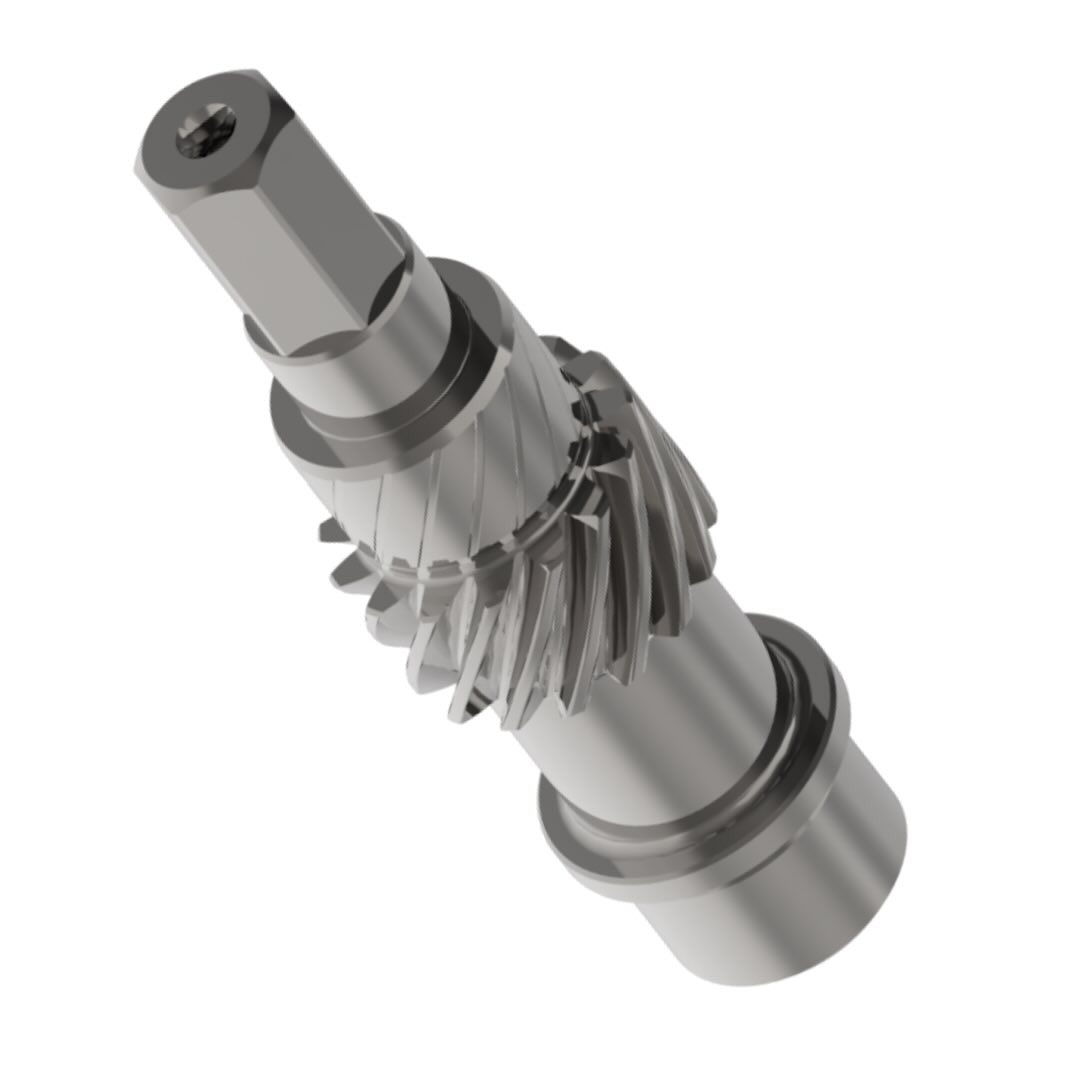
Spur gears: the right choice when space is limited and axial thrust must be avoided
Spur gears are often the ideal solution when a project requires simple construction, compact dimensions and no axial thrust. Since the teeth run parallel to the axis, they transmit motion without generating axial forces, simplifying the design of shafts and bearings and reducing overall system complexity.
They are particularly suitable for applications where noise levels and rotational speed are not critical factors, while reliability, compactness and cost-effectiveness are key priorities. The choice of tooth configuration therefore does not depend on one solution being inherently “better” than another, but on the actual requirements of the application and the performance expected.
Profile correction and tooth crowning, from the design stage
Much of our design support comes down to working alongside the customer’s technical office to develop the best possible tooth profile for the application: a correction or crowning that compensates for misalignment, while keeping the right balance between performance and cost. The calculation is carried out using DTS software, in line with ISO/DIN standards.
Technical expertise at your service
Our technical office stands out for its expertise in designing a wide range of drive system solutions, including customized linear actuators and bespoke epicyclic gearboxes.
FAQ
Straight-cut gears are toothed wheels with teeth cut parallel to the axis of rotation. It’s the simplest gear tooth geometry to produce: contact between the teeth happens across the full width at the same instant, giving efficient meshing with no axial thrust.
Straight-cut gears are the better choice when you need a gear that’s economical to mold, when there’s no room to fit bearings to absorb axial thrust, or when the application can’t tolerate any axial thrust at all. Helical gears remain the best option when you need lower noise and higher load capacity, in exchange for axial thrust that has to be managed at the design stage.
Both with hobbing and with skiving, we achieve a roughness below 0.8 Ra.
Straight-cut gears are clearly preferred in applications with zero allowed axial thrust, as well as in applications where the gears are molded, for the simplicity and lower cost of the mold. Where space in the gearbox is limited, and it isn’t possible to fit the necessary bearings, straight-cut gears are preferred specifically to limit axial thrust.
Much of our design support comes down to working alongside the customer’s technical office to develop the best possible profile for the intended application, optimized to strike the right balance between performance and cost.
We machine straight-cut gears in alloy and non-alloy steels, stainless steel, brass, bronze, and aluminum, as well as engineering plastics such as POM, Delrin, and PEEK, depending on the load, weight, and corrosion resistance the application requires.
We manufacture straight-cut gears with modules from 0.2 to 3, on outer diameters from a minimum of 4 mm up to 120 mm, with maximum lengths of 140 mm.
We need the complete technical drawing with module, tooth count, and any profile correction, the required quantity, material, gear quality grade, and any heat or surface treatments.